ICUV started to work on the issue of the confiscation of the Russian frozen assets in April 2023 and made it one of our key priorities. Within this area of work, the team’s key focus has been comprehensive analyses and researches into existing challenges, legal options and economic obstacles, as well as other roadblocks named by Ukraine’s partners, and offering optimal policy suggestions.
To facilitate the work, ICUV teamed up and united efforts with Ukrainian CSOs working on the matter (AntAC, ANTS, Center for Economic Strategy, Automaidan, Institute of the Legislative Ideas and others) and foreign partners, like top international law and finance experts, Razom for Ukraine and a broader circle of Ukrainian and foreign CSOs and communities. We also coordinated activities with the Ministry of Justice of Ukraine and the Ministry of Finance of Ukraine.
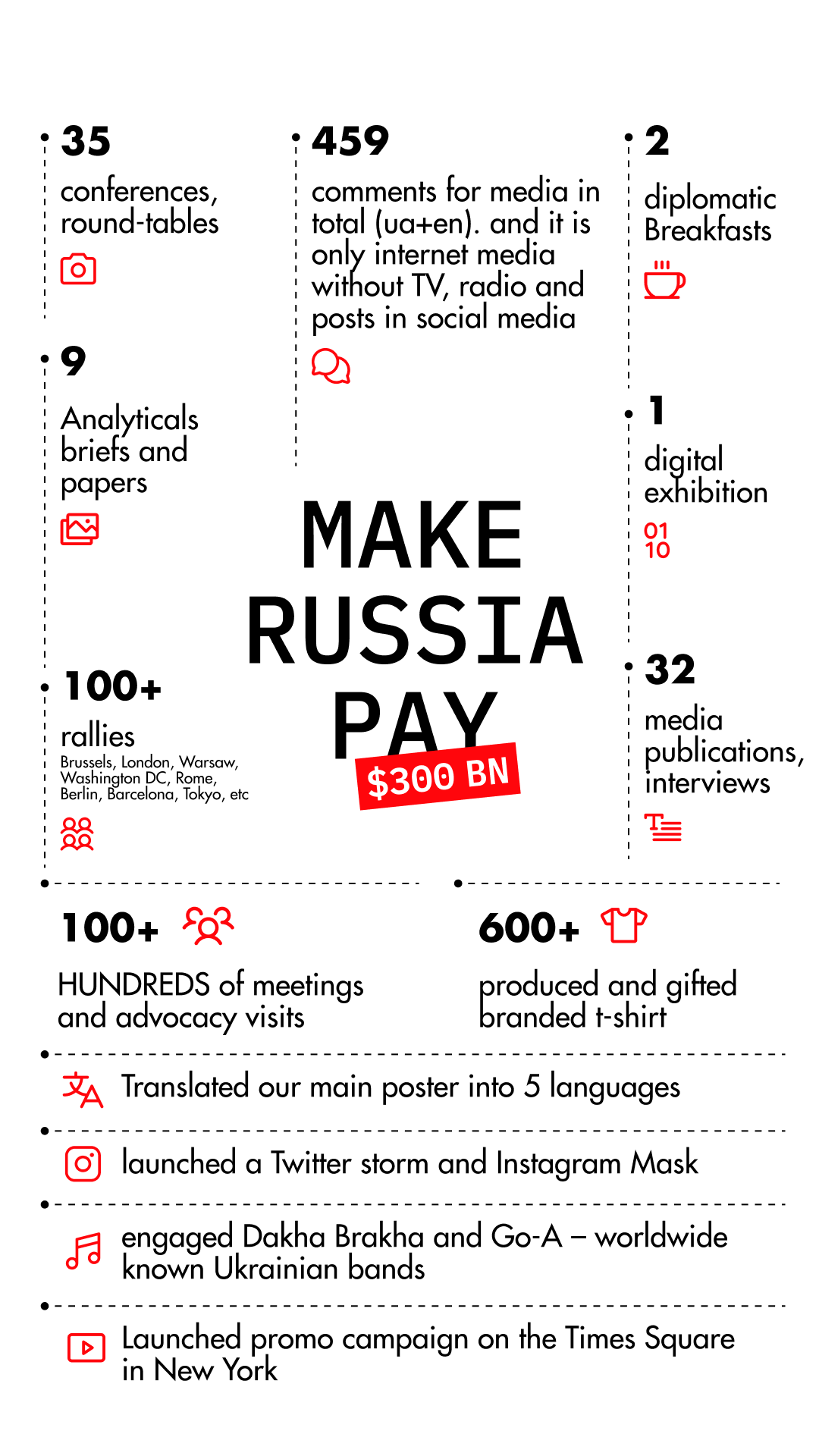
In order to present the findings of ICUV researches and analysis, the team has initiated and/or participated in a number of conferences, and roundtable discussions, did wide educational and informational activities, including writing the op-eds and giving interviews to the media, engaged in cultural activities like arranged a digital exhibition in Brussels and issued a bill for the Russian aggression to be displayed at the demonstrations and rallies across the globe.
Our first task was calling on for the establishment of an effective “seizure coalition” under the G7 umbrella and the advanced issue of audit, management, and introduction of prompt and effective mechanisms of seizure of Russian sovereign assets.
In June ICUV has conducted two visits to Belgium and the UK, during which Olena Halushka with the team had 31 meetings, including the high level ones with the UK Attorney General and the Secretary General of the European Commission, held a closed-door roundtable discussion at the Czech representation for the officials of the EU member states, British MPs, officials of different directorates general of the European Commission who work on the confiscation, think tanks like RUSI and OSEPI and others.
ICUV started to appear in the media, commenting on the issue, in particular, Halushka was quoted by the Times and Guardian on the topic, and gave an interview to the Monocle Radio, Lithuanian TV LRT. In addition, Halushka and Shevchuk published oped for KyivIndependent outlining the way forward with the confiscation of the Russian assets. The initial efforts contributed to toughening of some of the positions on the issue, particularly after ICUV’s visit to the UK in June “the UK is introducing new laws that will allow ministers to maintain Russian sanctions until compensation is paid to Ukraine, thus introducing a way for frozen Russian assets to be donated to Ukrainian reconstruction.”
In summer 2023 the campaign got its now trademark name Make Russia pay! Our message was that we are grateful to Western taxpayers, but for the sustainability of Ukraine’s self-defense, it is important to make Russia pay. In September, ICUV held a round-table in Kyiv with diplomats and experts to discuss the practical mechanisms for the confiscation of assets in favour of Ukraine. With this discussion, ICUV with our partners from ANTS, AntAc and Institute of Legislative Ideas, launched its large worldwide campaign, MAKE RUSSIA PAY, aimed to highlight the topic of confiscation of Russian assets (promo video here). Moreover, in September 2023 ICUV together with the “Institute of Legislative Ideas’ ‘ issued an analytical paper on the topic. The hashtag #MakeRussiaPay started to appear in Twitter recommendations.
In the next few months the ICUV team engaged in some heavy activities on the matter. Among some of the key activities were: the panel discussion on the “Confiscating Russian Assets: Legal and Political Opportunities” at the Warsaw Security Forum, visits to the Netherlands, Czech Republic, the US – in particular Olena Halushka was a speaker at the Hudson Institute event on “Making Russia Pay” with US Senator Jim Risch (here). In Brussels, Olena Halushka moderated a panel discussion titled “Who Will Pay and How the Russian Frozen Assets Will Be Used: Windfall Tax or Countermeasures?” at the high-level conference co-organised by the ICUV “European integration of Ukraine – the way to sustainable peace on the European continent” (Recording). The issue was also high on the agenda for ICUV team at the various closed-door events at the Halifax Forum.
Moreover, the digital exhibition “Make Russia Pay!” brought the campaign to Brussels for five days (YouTube; ICUV). Among high-level speakers who participated in the opening ceremony were: Natalia Anoshyna, Chargé d’Affaires a.i. de l’Ukraine auprès de Royaume de Belgique et au Grand-Duché de Luxembourg; Andrius Kubilius, Member of the European Parliament, Coordinator of the United for Ukraine Network; Kurt Volker, US Special Representative for Ukraine Negotiations (2017-2019), Olena Haluhska, ICUV co-founder, moderated by ICUV’s Iryna Krasnoshtan.
What is more, The Guardian published an article by Olena Halushka and Andrii Mikheiev titled “Here’s how to find more funds for Ukraine – liquidate Russia’s $300bn in frozen assets” which gained a big traction. Also Halushka’s column was published in the Ukrainian Pravda in English and Ukrainian. Halushka spoke at podcast Silicon Curtain, Ukraine World podcast and AntAC podcast, gave an interview to German think tank Atlantik Brucke, commented to The Times, French business magazine Challenges and others.
ICUV’s next policy paper “Confiscation Of Russian Sovereign Assets: Mission Possible And Overdue” strengthened our arguments for more informed activity. The official presentation of this policy paper was organized in Kyiv on December 7 and was attended by diplomats and experts.
In December #MakeRussiaPay campaign continued with a rally in Brussels. During the event a meter-long bill was displayed on the street listing Russia’s crimes in the war against Ukraine. These include damages inflicted by Russia on the Ukrainian economy, culture, housing sector, education, medicine, etc. The check indicates a sum of $300 billion that Russia can already pay for the committed offenses. The first #MakeRussiaPay action took place earlier in December in Washington DC and was organized by our partner NGO “Svitanok” who gathered people at the White House to demand a decisive action on the confiscation of Russian frozen assets as well as to provide sufficient weaponry for Ukraine’s victory without any further delay (Twitter). The second action within the #MakeRussiaPay campaign took place in Milan on December 3 and was organized with the support of the Communities Army of Ukraine (Twitter). One more event has taken place in Texas with the support of our partner organization Liberty Ukraine Foundation (Twitter). The MakeRussiaPay campaign was becoming global and more organisations and communities were joining it.
At the next stage ICUV continued working on engaging opinion leaders and experts in various capitals to further promote the idea. Moreover, ICUV continued to do in depth analytical documents, and reach out to audiences in different countries through public events, rallies and op-eds to “normalise” the narrative. ICUV cooperated closely with Razom, KSE, ILI, American and European legal scholars. We have also continued cooperation with Ukraine’s Ministry of Justice and Ministry of Finances.
In particular, in January, ICUV delegation made a speech in the Italian Senate regarding the importance of confiscating $300 billion of Russian assets (Twitter ; Twitter ; Twitter ; Vita ; RadioRadicale). In addition, during the visit to Rome they had at least 15 meetings, including with Benedetto Della Vedova, Secretary of “More Europe” (Twitter); with Senator Enrico Borghi (Twitter); Chair of the Committee on Foreign and European Community Affairs Giulio Tremonti, at the MFA and with the Ukrainian diaspora in Italy. Members of the delegation gave interviews to Vita italia and ilFoglio. Moreover, Italian La Repubblica published an article on seizing of the Russian assets quoting our campaign “Perche confiscare i beni di Mosca” 19 Feb 2024. On 2 March Correire della Serra – the main Italian paper – published a pro-seizing op-ed on its front page, also influenced by ICUV’s campaign.
In February, the campaign reached an important momentum, which was related to the 2nd anniversary of the Russian full-scale aggression against Ukraine. Around 30 rallies worldwide engaged 100,000 people in the campaign #MakeRussiaPay with printed bills.
In this month, ICUV conducted four visits. In particular, confiscation of the frozen assets was key for ICUV’s efforts at the “Cafe Kyiv” event in Berlin, which was attended by around 5 thousand guests (Facebook) – there was a dedicated panel discussion on confiscation of Russian assets where Olena Halushka highlighted the importance of confiscation of Russian assets and #MAKERUSSIAPAY campaign. What is more, ICUV delegation took part in the hearings at the EU affairs committee of the Bundestag on the issue of the confiscation of the Russian frozen assets, chaired by Anton Hofreiter, Chairman of the Committee, with participation of Members of the Bundestag Valentin Abel and Sebastian Shafer, and staff of the committee. During the visit to Barcelona Olena Halushka gave an interview to La Vanguardia where she spoke about the urgency to confiscate Russian frozen assets. During Olena’s visit to the Hague, where she spoke at the Symposium on the war in Ukraine where she also brought the #MakeRussiaPay USD 400 bln bill and emphasized on the need to confiscate Russian frozen assets for the needs of Ukraine (Twitter). On February 25-27 ICUV delegation led by Olena Halushka was on an visit in Brussels where they advocated for confiscation of Russian assets. They had fourteen meetings in two days, including with 10 Permanent Representations to the EU; with Anders Eide, Ambassador of Norway to the EU (Twitter); Cabinet of EU Commissioner for Justice Didier Reynders; Chief of Staff at the Office of the Prime Minister of Belgium, and others. In addition, ICUV delegation also participated in a numerous Ukrainian rally organized with partner NGO “Promote Ukraine”. The event gathered over 7000 participants in order to commemorate the second anniversary of Russia’s full-scale invasion of Ukraine and advocate for the confiscation of Russian assets (Twitter ; Twitter).
During her visit to Brussels in early March Daria Kaleniuk also had numerous interactions with the media discussing this matter, including an interview for Standaard.be, interview for Financial Times and interview for the Wall Street Journal.
As a result of the previous visits, numerous meetings, expert conversation, ICUV heard the arguments and reservations, and produced a set of updated analytical briefs on Ukrainian experience, fear of retaliation, and political argument. Moreover, a tailored brief for Germany was prepared by our partner in Germany lawyer Dr. Patrick Heinemann.
ICUV established partnerships with lawyers and experts in the field across Europe. Hence, Patrick Heinemann, German Lawyer, actively promotes this topic in his tweets (Twitter ; Twitter) and public discussions. On March 20 together with Olena Halushka he participated in the discussion “Frozen assets: The cold front of Russia’s war against Ukraine” organised by the Ukrainian Prism and the European Policy Centre (EPC ; Twitter). We also cooperate with Pierre Klein Professor, Centre for International Law Université Libre de Bruxelles, one of the co-authors of the brief on countermeasures and of this letter. Economist and ICUV partner Timothy Ash contributed to the MakeRussiaPay campaign by Tweeting his photo in an ICUV MakeRussiaPay T-shirt (Twitter). On the second anniversary of Russia’s war of aggression against Ukraine Anna Maria Corazza Bildt, MEP 2009-2019, recorded a video in the center of Kyiv wearing a #MakeRussiaPay T-shirt (Twitter). The hashtag #MakeRussiaPay gained popularity on Twitter – the thematic posts, selfies, pictures of rallies peaked at the period of the 2nd year anniversary of the full-scale invasion.
What is more, ICUV produced a number of articles and interviews for key international media advocating for the confiscation of russian assets in Italian La Repubblica, Norwegian Dn.no, Norwegian podcast on Spotify, French Le Monde, Belgian Standaard.be, Belgian De Tijd, opinion piece in FT, Euractiv, in German NTV, in Politico.
Also the topic was covered in Ukrainian media: Daria Kaleniuk for Ukrainian Radio, Interview in Youtube with Olena Halushka on OPORA’s Channel, Olena Halushka in an opinion piece for Ukrainska Pravda, Interview in Youtube with Olena Halushka on “There is a question” Channel, interview for the European Resilience Initiative Center (YouTube; Twitter).
Moreover, ICUV in cooperation with the Center for Civil Liberties and the Anti-corruption Action Center launched a Petition on confiscation of Russian assets in favor of Ukraine (Twitter). The petition was signed 6668 times and we continue promoting it.
ICUV also engages into information raising and educational activities, in particular empowering the communities across different countries with the knowledge and messages. Such non-public meetings took place with co-founders Hanna Hopko which reached around 30 representatives of local communities.
ICUV has also strengthened cooperation with partners internationally and formed relationships with Members of parliament and governments across key capitals engaged in this topic. Moreover, several important political steps were taken, such as mentioning of the confiscation in the German Bundestag resolution, Italy’s Senate resolution as well as a vote in support at the Switzerland Council of Nations. Italian MP mentioned specifically Olena Halushka and Hanna Hopko in his intervention at the Italian Chamber and highlighted key messages regarding the seizure of Russian frozen assets (Camera).
In April ICUV conducted at least three visits on the issue of the confiscation of the frozen assets, which was also closely linked due to the situation on the ground in Ukraine, to the focus on current needs, such as increased air defence and energy security. The delegation visited Paris, where they took part in the Ukraine-France Forum (Twitter ; Twitter) and held a number of bilateral meetings, with French politicians, governmental officials and representatives of think tanks, including with advisers to President Macron, former MP Constance Le Grip (Twitter; Twitter) and Jean-Noel Barrot, Secretary of State for European Affairs (Twitter). They also took part in the roundtable discussion at the Ministry of Defence and Ministry of Finance of the French Republic. Later the delegation was on an visit in Rome, where they took part in the closed-door round-table discussion “Ukrainian Victory. How to bring peace back to Europe”, an event co-organised by the Embassy of Ukraine in Rome and the Embassy of the Republic of Poland in Rome in cooperation with the Italian Federation for Human Rights (FIDU) and the European Council on Foreign Relations (ECFR) with participation of representatives of embassies, experts, and journalists (Twitter ; Twitter ; ECFR). Additionally, they had meetings with high-level officials, including, with the advisor to Prime Minister of Italy Giorgia Meloni, with Ambassador Giulio Terzi (Twitter) and Lia Quartapelle, Member of the Chamber of Deputies of Italy. They also had a fruitful discussion with Nathalie Tocci, Director of the Istituto Affari Internazionali (Twitter). This visit was particularly important in light of Italy’s G7 presidency and upcoming G7 summit. ICUV team was also in Oslo, where they took part in the conference “Ukraine: Now More than Ever”, in particular Olena spoke at the panel “How effective are the sanctions in thwarting the Russian war efforts?” (Facebook). Delegation also had meetings at the Norwegian Parliament, including with MPs Åsmund Aukrust and Helge Orten, representatives of the MFA, Labour Union, security experts, and researchers.
In May ICUV conducted at least five visits and events, including Daria Kaleniuk raised the issue at the closed door event “Ditchley conference. The implications of a long war in Ukraine on European security and on deterrence for the wider democratic world” in England, Olena Halushka was among speakers at the closed-door session “Holding Russia Accountable – From Freezing to Seizing Russian Assets” at the Lennart Meri Conference 2024 in Tallinn, Iryna Krasnoshtan joined the Ukraine Security Forum: a tipping point for Europe’s security and democracy (Programme) in Brussels, where she spoke at the round-table discussion on confiscation of Russian frozen assets “Unfreezing Russian Frozen Assets”. ICUV’s delegation also visited Brussels, where they advocated for the confiscation of Russian assets with several meetings with European Commision,Embassies and missions and journalists, as well as Japan where the delegation had several meetings including: at the Ministry of Foreign Affairs of Japan, Ministry of Defense, Ministry of Justice, Ministry of Economy, Ministry of Finance; with influential and active parliamentarians; governmental agencies, NGOs and media, as well as joined the #MakeRussiaPay rally in Tokyo (Twitter ; Twitter).
In April and May, ICUV continued its work with local communities in various countries and mobilisation of citizens to the #MakeRussiaPay campaign across the EU. In particular, on April 3 the ICUV took part in a rally in Paris (Twitter), and co-organised together with the Union des Ukrainians de France a big MakeRussiaPay rally on April 6 (Instagram ; Facebook ; Twitter ; Twitter). During the visit to Oslo Olena Halushka made a speech at the daily demonstration in front of the Norwegian Parliament (Twitter). On April 11 Maria Koshkina took part in the rally “Euroclear: we are watching you” aimed at demanding confiscation of Russian frozen assets (Twitter ; Twitter ; Instagram) organised by our partner Promote Ukraine, NGO. On April 12 ICUV co-organised a similar demonstration in the Netherlands (Twitter). On April 18 the MakeRussiaPay demonstration took place in front of the Russian embassy in Ottawa (Twitter). On May 8 ICUV co-organised a #MakeRussiaPay demonstration in Berlin (Photo). On May 13 ICUV carried out another #MakeRussiaPay rally with the participation of Belgian Senator Mark Demesmaeker and MEP Johan Van Overveldt (ICUV). On May 26 in cooperation with the local NGO Stand With Ukraine in Japan ICUV held the #MakeRussiaPay rally in Tokyo (Twitter ; Twitter). Within the framework of the #MakeRussiaPay campaign, Andrii Mikheiev, ICUV international lawyer also recorded a video address speaking on the EU’s decision to confiscate revenues from the frozen Russian assets and calling upon the full confiscation and transferring of the assets to Ukraine (Twitter).
ICUV also published a number of articles and comments, including Belgian Flemish media Le Vif published an article with commentary by Daria Kaleniuk “Belgium is singled out in Ukraine for its supposed reluctance to use the windfall of Russian assets blocked at Euroclear”, Ukrainian Pravda published a column by Olena Haluhska “Russia will pay for the war: how the US took an important step to confiscate $300 billion in Russian assets”, G7 leaders to discuss €30bn loan for Ukraine using Russian assets | Ukraine | The Guardian (features Olena Halushka’s comment); the special edition of ICDS Diplomaatia features Olena Halushka’s article on Make Russia Pay. Printed versions were distributed at the conference, on-line versions in English and Estonian; Biz.Liga published an article including commentary by Olena Halushka “What are Russian assets in the world and how to confiscate them”; ZN published an article by Olena Halushka “Frozen Russian Assets. Should We Rely On Their Transfer To Ukraine”.
In June, Olena Halushka was at the Ukraine Recovery Conference in Berlin to advocate in particular for the confiscation of Russian assets. She had a speaking role at the panel discussion “Ownership, transparency and integrity in recovery”, as well as spoke at additional events, including at the URC side event: “Using frozen Russian assets for the reconstruction of Ukraine” roundtable (Agenda) organised by Friedrich Naumann Stifftung. There she also met Rt Hon Lord David Cameron and expressed gratitude for his support to Ukraine, in particular, regarding the confiscation of Russian assets (Twitter).
There were several more publications in media on the topic, including Olena Halushka gave an interview to Pryamyi TV Channel speaking about the Russian frozen assets; An opinion by Olena Halushka was published by Antac; An opinion piece “On the eve of the G7 summit: awaiting a decision on confiscation of Russian assets” by Olena Halushka was published in the Ukrainian Pravda.
Several more rallies were held ahead of the G7 Summit. On June 5 the #MakeRussiaPay demonstration took place in Vilnius (Twitter); on June 6 in Berlin (Twitter) and Warsaw (Twitter); on June 8 ICUV in cooperation with the Union des Ukrainiens de France organised the #MakeRussiaPay march in Paris (Announcement ; Twitter ; Twitter); on June 11-12 the #MakeRussiaPay demonstrations took place across Italy: Modena (Twitter) Bari, Florence and Fasano (Twitter); on June 12 the #MakeRussiaPay demonstrations took place in Brussels where Mark Demesmaeker, Belgian MP, performed a Ukrainian anthem (Twitter); ICUV’s #MakeRussiaPay digital signage was screened on Times Square in New York (Twitter).
We want to thank everybody who joined us in any way they could by joining demonstrations in the cities or using our branded mask in stories, etc. We also want to say special thanks to the Communities Army of Ukraine and to each Ukrainian local community in Europe, USA and Japan. Each of you brings us close to our main goal – Ukrainian victory.